Saturday, 17 September 2016

Hardy's Wessex: Puddletown Parish Church


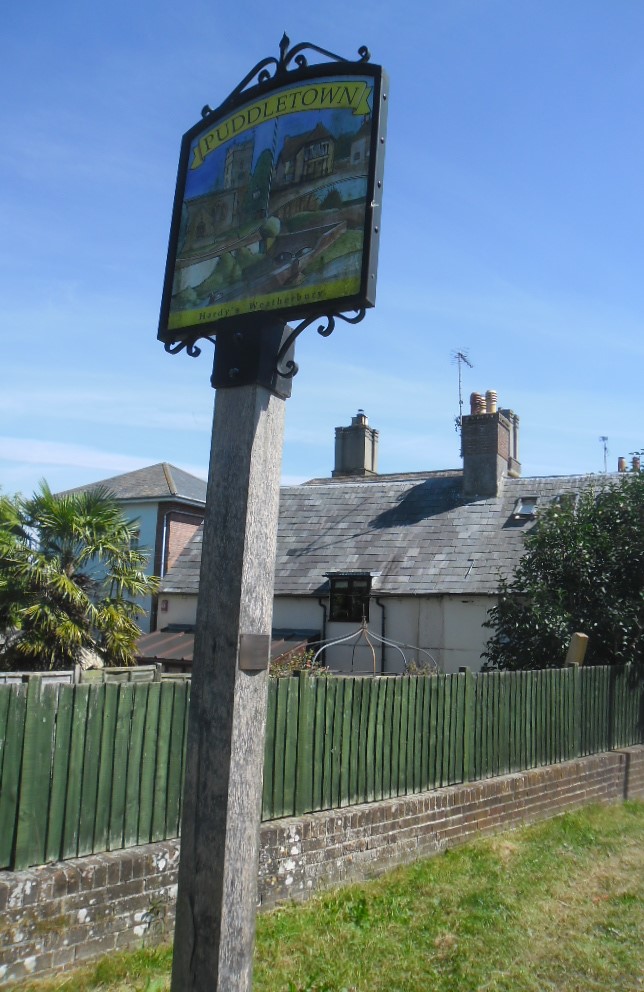
After going through Puddletown Forest ('Egdon Heath') for a while, I came across Puddletown, the model for Weatherbury in Thomas Hardy's 'Far from the Madding Crowd'.

The parish church of St. Mary's the Virgin was my main point of interest here.  Just read that Hardy's grandfather played the violin in the musician's gallery at the church, and that his uncle, John Antell, often said to be the model for Jude in 'Jude the Obscure', is buried somewhere in the graveyard here.


However, my main reason for visiting the church was that I could remember the macabre 'Weatherbury church' scene from 'Far from the Madding Crowd' where gushing water from a gargoyle spout washes away Frank Troy's flowers from the top of poor Fanny Robin's grave.


The picture of Puddletown parish church tower below seems to contain a couple of gargoyles at the top, but I'm not 100% sure:


Just read that Puddletown parish church dates back to Norman times, although much rebuilding work was done in the 15th century.

Friday, 16 September 2016

Hardy's Wessex: Entering 'Egdon Heath' (Puddletown Forest)


Shortly after visiting the Thomas Hardy childhood/early adulthood, Higher Brockhampton cottage, I found myself entering Puddletown Heath (now a forest), the model for Hardy's 'Egdon Heath' in 'The Return of the Native':


As can be seen, the heath/forest was full of tall trees:


And the occasional bundle of tree trunks:


It's a real pity I only got round to reading J.B. Bullen's 'Thomas Hardy: The World of His Novels' after visiting Hardy country, as the chapter on 'The Return of the Native' gives directions for finding the possible locations of 'Mistover Knap'; 'Rainbarrow' etc. in the heath/forest.


Thursday, 15 September 2016

Hardy's Wessex: Catapults at Higher Bockhampton


One of the interesting things I saw at Higher Bockhampton, what look like very well-made catapults being sold outside a cottage.

In general, Higher Bockhampton is a pleasant-looking village.


Wednesday, 14 September 2016

Hardy's Wessex: Glimpsing Higher Bockhampton Cottage


After a night sleeping under the stars somewhere between Thomas Hardy's childhood/young adulthood church at Stinsford and his childhood/young adulthood home at Higher Bockhampton, I made my way to the latter quite early in the morning.

Hardy's Higher Bockhampton cottage is a few minutes walk up from the visitors' centre (where I got a delicious breakfast with vegetarian sausages) through wooded land:


Near the Hardy cottage, I came across the small monument in Hardy's honour below which was erected by some American admirers in 1931:


The monument reveals that Hardy wrote both 'Under the Greenwood Tree' and 'Far from the Madding Crowd' while still living at the Higher Bockhampton cottage.

Unfortunately, it was a Tuesday and the Hardy cottage was not open for viewing, so, at first, I struggled to glimpse it through the dense foliage:


But eventually my camera managed to zoom in on the front of it:


And I could walk past the back of it:


Still, I would have to visit the cottage later in the week to get inside the place.

Have just read in J.B. Bullen's 'Thomas Hardy: The World of His Novels' that the Higher Bockhampton cottage represents the model for the Yeobright home in 'The Return of the Native'.  Just wish I'd read this incredible book and Margaret Marande's 'The Hardy Way: a 19th Century Pilgrimage' before setting out on my journey into Hardy country.


Bury (Lancashire): Pilgrims' Cross Monument on Holcombe Moor


For years, I'd heard about there being a Pilgrims' Cross up on Holcombe Moor, so when I was in my hometown of Bury, Lancashire last month, I decided to go and have a look for this with a group of friends:


When we found the place, we discovered there was only a cube-type monument, as the original cross had disappeared, nobody seems to know exactly when, while its original foundation had been vandalised in 1901, the present cube being installed in 1902.


However, the original Pilgrims' Cross, which the present cube-type monument commemorates, seems to have been built in the early 12th century or even earlier as a resting place (and place of prayer) for Catholic pilgrims on their way to Whalley Abbey (another wonderful, Romantic place in Lancashire).


Tuesday, 13 September 2016

Kerry: From the Maharees to Spillane's Bar


To get to Spillane's bar, we headed up the Maharees beach stretch/road towards Fahamore.


As we got closer to Spillane's bar, the beach contained a lot more seaweed:


Below, my friend is enjoying some refreshment while waiting for his gourmet beefburger (delicious) at Spillane's bar:


Monday, 12 September 2016

Kerry: The Maharees


After getting to Castlegregory from Camp, we extended our walk to the Maharees beach stretch where we set up camp for the night:


Early evening, the Maharees was an incredible sight:


Loud, booming waves and incredible white beams of light from the sky.


This was one of the most magical places I've ever visited (the top picture conveys something of the immensity of the experience).