Taylor (2007) records the massive
changes that have occurred in Western religious practice from pre-Reformation, medieval
times up to the modern-day, with a fall in Western religious practice and rise
of (materialist/humanist) unbelief narratives being clearly visible, especially
over the past 200-300 years. In great detail, Taylor (2007) discusses the
many complex twists and turns of the latter phenomena, with it being far from a
straightforward linear process of scientific discovery and technological
innovation making religious practice redundant, as the latter mutates and
survives, albeit in shrunken form. Moreover, Taylor (2007) repeatedly points
towards a pro-secularist ideological outlook which denigrates
religious practice having been necessary, alongside scientific discovery,
technological innovation, mass movement to big urban environments etc., to make
religion less meaningful in many people’s lives and minds. Interestingly, the upshot of
all this is what Taylor (2007) refers to as a “super-nova” effect through which
most people in the West are now exposed to almost limitless amounts of belief and
unbelief systems, which increasingly makes a traditional handing down of a
particular religion from generation to generation more difficult and increasingly a thing of the
past.
In Taylor’s (2007) account, some of the many significant historical processes, situations, and episodes that he deals with include:
-
pre-Reformation/pre-Counter Reformation Catholicism
-
16th century Reformation/Birth of Protestantism (Anglicans, Calvinists,
Lutherans, Anabaptists etc.)
-
16th/17th century Counter-Reformation (e.g. the Catholic
Church shaking off local, folk-level superstitions)
-
17th century: European Catholic-Protestant religious wars coming to
an end; Descartes (1596-1650) opening the way for the Enlightenment
-
18th century: Kant (1724-1804) pushing the Enlightenment forward; the
French Revolution (1789) destroying the idea of national monarchy; the 1789
American Constitution allowing greater individual liberty and less state interference
than European political formats; the Industrial Revolution and mass movement
from the countryside to towns/cities; and the birth of smaller Protestant
denominations (e.g. Methodists)
-
19th century: Ongoing development of Romanticism (Blake, Wordsworth,
Coleridge etc.); Second Great (Protestant) Religious Awakening and Birth of
Mormonism in early 19th century; Darwin’s (1809-1882) theory of
evolution and Karl Marx’s (1818-1883) egalitarian socio-economic theory
prompting accelerated growth of unbelief options etc.
-
20th century: 1917 Russian Bolshevik Revolution (birth of state communism); the mass death of the First (1914-1918) and Second World Wars (1939-1945); Bloomsbury
Group and Frankfurt School (critical theory) attacking Classical ideas in Western
academia; post-War questioning of ideological and religious meta-narratives; the
1960s Cultural/Sexual Revolution, Second Vatican Council, and ongoing rebellion
against traditional moral/religious values.
-
21st century: the accelerated spread of woke/globalist ideology and ideological
attacks against the remnants of Christianity; an attempted push-back against
woke/globalist ideology.
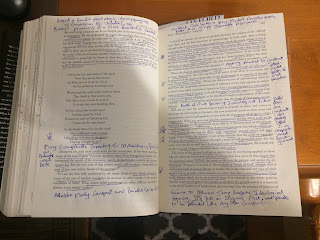
While reading this great book, I continually find myself using a pen to focus my attention better and do the book justice:
I also tend to read the book just after midday, while I'm cooking dinner, when my mind is usually at its sharpest.