Zwierzyniec lies about 7-10 miles away from my wife's hometown of Szczebrzeszyn in eastern Poland. I usually visit Zwierzniec during the summer, as its a peaceful and scenic kind of holiday place with gentle woodland treks and small lakes where people go swimming. Thus, it was interesting to visit this small holiday place at Christmas time when it was full of snow:
The pictures above are of the 18th century Baroque 'Church on the Lake'. During the summer, brides can be often seen arriving by traditional horse-and-cart to get married, as this church provides a perfect Romantic setting for a wedding day.
Just around the corner from the 'Church on the Lake', you can see the now sadly closed brewery at Zwierzyniec:
In summer, there is a beer garden usually open here, where you can drink both Zwierzyniec and Perła on tap (like Perła, I think Zwierzyniec is now brewed in Lublin). Moreover, if you enlarge these pictures and look carefully, you'll see the crucifix on the front of the building, a positive sign that this part of the world is still Christianised, and still remains largely untouched from the drab disenchantment and meaninglessness of Western politically-'correct' ideology.
Further up the wooded road away from the brewery, there are the small lakes and wooden lookout point for trying to spot the 'Koniky' (wild horses found in this area of Poland:
Unfortunately, the 'Koniky' weren't visible on Christmas Day, as they were probably in the forest looking for food. However, it looked like another wonderful animal had been at work nearby:
Yes, it looked like the industrious beaver had been hard at work over Christmas, but my wife suggested that this may've been just set up as some kind of joke by somebody. Still, it was nice to believe that the beavers had been hard at work, and were just having a short break for Christmas Day.
Saturday, 29 December 2012
Friday, 28 December 2012
The Children's Concentration Camp, Zwierzyniec, Eastern Poland
On Christmas Day, me, my wife and father-in-law visited a church commrmmorating a Children's Concentration Camp from the 2nd World War in/near Zwierzyniec in eastern Poland:
Yes, it's difficult to get your head round, but the Nazis actually had a concentration camp for Polish children in this area of Poland. From many Western politically 'correct' accounts of the 2nd World War, you get the false impression that only Jews were killed in the concentration camps in Poland, something that many Polish people quite rightly feel angry about, as many Poles and other Slavs (non-Jews) were slaughtered in the Nazi extermination camps.
Inside the church commemorating the children's concentration camp, there is actually a small model of the camp blocks that housed the small (often infant) inhabitants:
Just above this model of the concentration camp for children, there is a painting of the Catholic martyr saint of Auschwitz, St. Maximilian Kolbe:
When I visited Auschwitz I at Oswięcim, I was shown both the underground chambers where the Jews were gassed, and the shooting range where many Poles and other Slavs were shot. What particularly shocked me were the many empty blocks and massive lists of names devoted to Serbs who were slaughtered at Auschwitz Oswięcim (I'm talking about Auschwitz I here, not Auschwitz II at Birkenau), something you never hear of in Britain.
Still, this was Christmas Day after all, and there was a manger inside the church to remind us all of this:
Always loved the story of the Three Wise Men of the East.
Yes, it's difficult to get your head round, but the Nazis actually had a concentration camp for Polish children in this area of Poland. From many Western politically 'correct' accounts of the 2nd World War, you get the false impression that only Jews were killed in the concentration camps in Poland, something that many Polish people quite rightly feel angry about, as many Poles and other Slavs (non-Jews) were slaughtered in the Nazi extermination camps.
Inside the church commemorating the children's concentration camp, there is actually a small model of the camp blocks that housed the small (often infant) inhabitants:
Just above this model of the concentration camp for children, there is a painting of the Catholic martyr saint of Auschwitz, St. Maximilian Kolbe:
When I visited Auschwitz I at Oswięcim, I was shown both the underground chambers where the Jews were gassed, and the shooting range where many Poles and other Slavs were shot. What particularly shocked me were the many empty blocks and massive lists of names devoted to Serbs who were slaughtered at Auschwitz Oswięcim (I'm talking about Auschwitz I here, not Auschwitz II at Birkenau), something you never hear of in Britain.
Still, this was Christmas Day after all, and there was a manger inside the church to remind us all of this:
Always loved the story of the Three Wise Men of the East.
Thursday, 27 December 2012
The Jewish Cemetery, Szczebrzeszyn
When in Szczebrzeszyn, I always find time to go in the Old Jewish Cemetery, as it does have some kind of presence: still and serene with the odd brown squirrel darting about above:
Just in front of the sign above, there is some other information introducing the place as one of the best kept Jewish cemeteries in Poland. Like the Jewish cemetery in Warsaw, the place is more on the rugged than the (strictly) neat side, but, apparently, this is the way the Jews like their cemeteries to be kept. Even though I only had my mobile camera on me here, I was luckily able to catch something of the colourful and ornate design of the gravestones, as you can see below:
From out of this, I can't help but like the fact that the Jews put some effort into their gravestones, showing that they care for their dead.
Just in front of the sign above, there is some other information introducing the place as one of the best kept Jewish cemeteries in Poland. Like the Jewish cemetery in Warsaw, the place is more on the rugged than the (strictly) neat side, but, apparently, this is the way the Jews like their cemeteries to be kept. Even though I only had my mobile camera on me here, I was luckily able to catch something of the colourful and ornate design of the gravestones, as you can see below:
From out of this, I can't help but like the fact that the Jews put some effort into their gravestones, showing that they care for their dead.
Good Food in Szczebrzeszyn over Christmas
Just back from Szczebrzeszyn in eastern Poland where me and my wife spent a few days with her parents over Christmas. While travelling there, we stopped off at a wonderful traditional Polish restaurant near the small town of Ryki on the Warsaw-Lublin road. What you can see below is the meal I had: pork joint, oiled salad; grilled pepper, fried mushrooms, and mashed potatoes. Yes, this was genuinely scrumptuous.
Inside the restaurant, it was like being in a museum, my favourite antique piece being the small rocking horse below:
As usual, I also really enjoyed my mother-in-law's homemade food which included the following:
1. Vegetarian Gołąbki with some kind of oatmeal and rice (rather than the traditional pork) inside the cabbage leaves
2. Babcia's (Grandma's) Biscuits - these are better eaten just after being cooked, as they have an incredible buttery taste
3. Apple and Walnut Cream Sponge Cake and Soft Raspberry Cheesecake
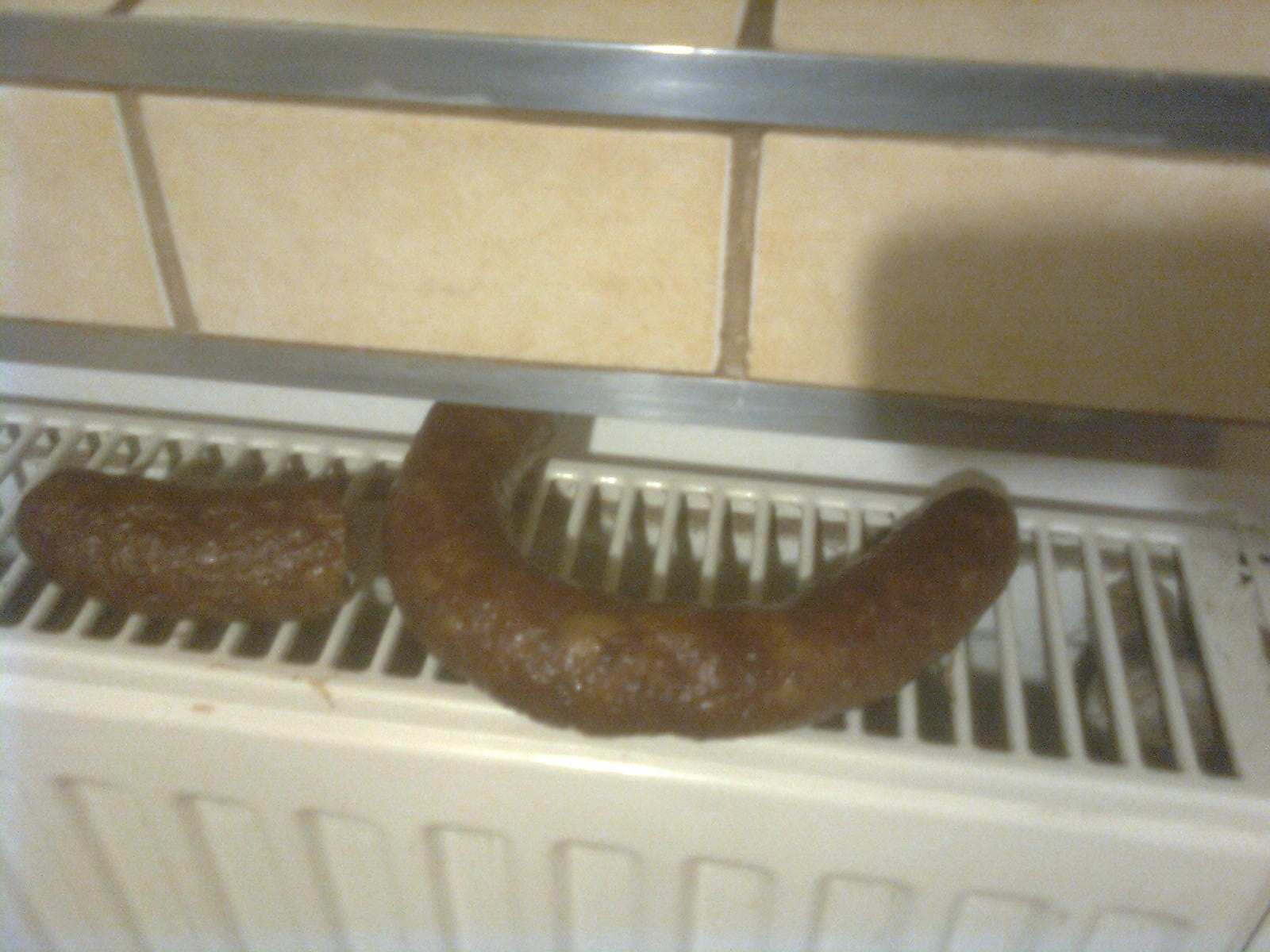
4. Homemade Kiełbasa (Sausage) cooked on top of a radiator - this really is the best way of cooking homemade sausage, although it does require a certain amount of patience.
Inside the restaurant, it was like being in a museum, my favourite antique piece being the small rocking horse below:
As usual, I also really enjoyed my mother-in-law's homemade food which included the following:
1. Vegetarian Gołąbki with some kind of oatmeal and rice (rather than the traditional pork) inside the cabbage leaves
2. Babcia's (Grandma's) Biscuits - these are better eaten just after being cooked, as they have an incredible buttery taste
3. Apple and Walnut Cream Sponge Cake and Soft Raspberry Cheesecake
4. Homemade Kiełbasa (Sausage) cooked on top of a radiator - this really is the best way of cooking homemade sausage, although it does require a certain amount of patience.
Wednesday, 19 December 2012
Pictures of General Franco on Display in Barcelona
This post is devoted to some incredible pictures on display in Catalunya Square, Barcelona when I visited the city 2-3 years ago:
Yes, the pictures were of none other than General Francisco Franco, the Spanish leader who saved the Iberian peninsula from Sovietisation (Stalinisation) process. Just for the record, my own view of the General is that he was the less of the two evils in the Spanish Civil War, but having said that, I was somewhat shocked to see his image being so publically shown in modern-day Catalonia.
In particular, I found the pictures of the General attending the Old Latin Mass absolutely fascinating:
Yes, General Franco was a devout practising Catholic, and on his deathbed, some of his final words are said to have been that he devoted his life to saving Catholic Spain from Sovietisation (Stalinisation) process. For me, on one hand, I don't view the General as a saint, but on the other hand, I don't swallow the politically 'correct'-type revisionist account of him being a monster.
However, I must reiterate that I was shocked to see such pictures being shown publically in the heart of Barcelona. Moreover, some of the other pictures on display showed soldiers and people who appear to be attending the same Old Latin Mass as the General, and if these people are the General's soldiers and supporters, the pictures really are fascinating, as they are humanising rather than demonising the people:
Thus, after seeing these pictures, I'm left with the question of whether the memory of General Franco is no longer a massive problem for Catalonians, or, less likely, that they now offer some kind of begrudging respect to the leader who saved the Iberian peninsula from Sovietisation (Stalinisation) process.
Yes, the pictures were of none other than General Francisco Franco, the Spanish leader who saved the Iberian peninsula from Sovietisation (Stalinisation) process. Just for the record, my own view of the General is that he was the less of the two evils in the Spanish Civil War, but having said that, I was somewhat shocked to see his image being so publically shown in modern-day Catalonia.
In particular, I found the pictures of the General attending the Old Latin Mass absolutely fascinating:
Yes, General Franco was a devout practising Catholic, and on his deathbed, some of his final words are said to have been that he devoted his life to saving Catholic Spain from Sovietisation (Stalinisation) process. For me, on one hand, I don't view the General as a saint, but on the other hand, I don't swallow the politically 'correct'-type revisionist account of him being a monster.
However, I must reiterate that I was shocked to see such pictures being shown publically in the heart of Barcelona. Moreover, some of the other pictures on display showed soldiers and people who appear to be attending the same Old Latin Mass as the General, and if these people are the General's soldiers and supporters, the pictures really are fascinating, as they are humanising rather than demonising the people:
Thus, after seeing these pictures, I'm left with the question of whether the memory of General Franco is no longer a massive problem for Catalonians, or, less likely, that they now offer some kind of begrudging respect to the leader who saved the Iberian peninsula from Sovietisation (Stalinisation) process.
Sunday, 16 December 2012
Warsaw: Freely Celebrating Christmas
In my native Great Britain, it is often difficult to celebrate Christmas freely and properly, because the politically 'correct' dictatorship claims that it's a time of year which 'discriminates' against Jews, Muhammadans, and other non-Christians. However, I remember a good Catholic bishop once saying that "Political 'correctness' is for imbeciles", and wouldn't go out of my way to disagree with this opinion, although the remark may be a little tough on imbeciles.
In contrast, away from the politically 'correct' insanity in Great Britain, I'm really grateful that I can openly celebrate Christmas (as a Christian) in Poland. Thus, when I saw a friend, Gary, for the first time in 30 years (since our schooldays) in Warsaw this weekend, I thought it would be a good idea to go looking at the Christmas decorations down near the Old Town. However, before doing this, we first had a look at a snow-laden Lazienki Park:
Yes, the Royal Palace (on the lake) looked almost mystical in the darkness. The two pictures below, from a tourist information site, show what the Royal Palace looks like during summer:
Now, after Lazienki, we made our way down to the Old Town on the 116 bus, where we found a wonderful Christmas atmosphere near and around the Royal Castle:
Absolutely love how the bushes above have been shaped and adorned with lights to look like Christmas present boxes.
Yes, the 'boxes' were there again at the foot of the Christmas Tree near the Royal Palace. What you probably can't see is that a deft falling snow was adding to the seasonal atmosphere. For me, the softness of fresh snow is like sunlight, it simply uplifts the soul.
Yes, there was a sense of awe and wonder, many people were going to be at Mass the following day, and sometimes it just feels great to live in a country that is still unashamedly Christian (Catholic). The final picture below is of the old Gothic church at the back end of the Old Town (the old Town is full of churches).
Finally, I'll end this post with 'All Around My Hat' by Steeleye Span (on a German TV show from the 1970s).
Not sure if I'm right in viewing this as a Christmas song, but I have some really good memories of dancing around drunk to it at Christmas time in pre-politically 'correct' Britain. If only Britain could turn back the clock . . .
In contrast, away from the politically 'correct' insanity in Great Britain, I'm really grateful that I can openly celebrate Christmas (as a Christian) in Poland. Thus, when I saw a friend, Gary, for the first time in 30 years (since our schooldays) in Warsaw this weekend, I thought it would be a good idea to go looking at the Christmas decorations down near the Old Town. However, before doing this, we first had a look at a snow-laden Lazienki Park:
Yes, the Royal Palace (on the lake) looked almost mystical in the darkness. The two pictures below, from a tourist information site, show what the Royal Palace looks like during summer:
Now, after Lazienki, we made our way down to the Old Town on the 116 bus, where we found a wonderful Christmas atmosphere near and around the Royal Castle:
Absolutely love how the bushes above have been shaped and adorned with lights to look like Christmas present boxes.
Yes, the 'boxes' were there again at the foot of the Christmas Tree near the Royal Palace. What you probably can't see is that a deft falling snow was adding to the seasonal atmosphere. For me, the softness of fresh snow is like sunlight, it simply uplifts the soul.
Yes, there was a sense of awe and wonder, many people were going to be at Mass the following day, and sometimes it just feels great to live in a country that is still unashamedly Christian (Catholic). The final picture below is of the old Gothic church at the back end of the Old Town (the old Town is full of churches).
Finally, I'll end this post with 'All Around My Hat' by Steeleye Span (on a German TV show from the 1970s).
Not sure if I'm right in viewing this as a Christmas song, but I have some really good memories of dancing around drunk to it at Christmas time in pre-politically 'correct' Britain. If only Britain could turn back the clock . . .
Friday, 14 December 2012
Brandon Village, County Kerry, Ireland
Time for another piece of travelogue writing, I think.
Legend has it that my mother's side of the family whose surname is Brandon originate from Brandon village in county Kerry, Ireland. However, all that we know for certain is that our family of Brandons came over to Lancashire (to work as weavers) from Thurles in county Tipperary in 1822, and this is where the family tree seems to stop, so the rest is pure speculation.
Despite the above, the idea of my mother's side of the family originating from Brandon Bay has always stuck with me, as I've always been a Romantic drawn towards enchantment. Thus, last year in early August, my friend Northsider Dave and his kind wife took me and my wife over the Connor Pass and down into Brandon village in deepest county Kerry. The drive over the Conor Pass was incredible, and I remember looking down at the wonderful scenery below (yes, it's quite some way down!):
Many thanks to the travel site that provided this picture.
However, my main reason for going to Brandon village was that my mother was dying of cancer in Paper Town (Bury), and I just had to see the 'mythological' origins of her side of the family. And when we got to Brandon, I wasn't disappointed.
As Brandon village is set on the Kerry coast, surrounded by a host of dark brooding mountains, the place is an isolationist's dream: you can simply encounter your deepest self there.
At the centre of the village, there is a nice, homely pub, but in the picture below you can see some locals at work crab-fishing. What particularly fascinated me in Brandon was the sense of awe that a group of teenagers seemed to get from seeing visitors from the 'outside world'. As there's little to do in Brandon, these teenagers must've been dreaming about how, when and where they would enter that big wider world. Of course, I wish them all well wherever their destinies take them.
The next picture below is of Northsider Dave's faithful Jack Russell hound, Fido, swimming in Brandon, and she seems to be in her element, doesn't she?
Yes, it may only be an isolated crab-fishing place in the middle of nowhere, but I felt something at Brandon, and, who knows, maybe my mother's side of the family does originate from there, after all. Of course, my mother died last year, but my memories of Brandon's stillness and tranquility give me some sense of peace.
The last picture below is of (a badly overweight) me standing with Brandon Bay and some of the surrounding mountains lying in the background.
Thankfully, the beer belly has now gone. Would love to go back to Brandon for a couple of days some time, as I love the place.
Legend has it that my mother's side of the family whose surname is Brandon originate from Brandon village in county Kerry, Ireland. However, all that we know for certain is that our family of Brandons came over to Lancashire (to work as weavers) from Thurles in county Tipperary in 1822, and this is where the family tree seems to stop, so the rest is pure speculation.
Despite the above, the idea of my mother's side of the family originating from Brandon Bay has always stuck with me, as I've always been a Romantic drawn towards enchantment. Thus, last year in early August, my friend Northsider Dave and his kind wife took me and my wife over the Connor Pass and down into Brandon village in deepest county Kerry. The drive over the Conor Pass was incredible, and I remember looking down at the wonderful scenery below (yes, it's quite some way down!):
Many thanks to the travel site that provided this picture.
However, my main reason for going to Brandon village was that my mother was dying of cancer in Paper Town (Bury), and I just had to see the 'mythological' origins of her side of the family. And when we got to Brandon, I wasn't disappointed.
As Brandon village is set on the Kerry coast, surrounded by a host of dark brooding mountains, the place is an isolationist's dream: you can simply encounter your deepest self there.
At the centre of the village, there is a nice, homely pub, but in the picture below you can see some locals at work crab-fishing. What particularly fascinated me in Brandon was the sense of awe that a group of teenagers seemed to get from seeing visitors from the 'outside world'. As there's little to do in Brandon, these teenagers must've been dreaming about how, when and where they would enter that big wider world. Of course, I wish them all well wherever their destinies take them.
The next picture below is of Northsider Dave's faithful Jack Russell hound, Fido, swimming in Brandon, and she seems to be in her element, doesn't she?
Yes, it may only be an isolated crab-fishing place in the middle of nowhere, but I felt something at Brandon, and, who knows, maybe my mother's side of the family does originate from there, after all. Of course, my mother died last year, but my memories of Brandon's stillness and tranquility give me some sense of peace.
The last picture below is of (a badly overweight) me standing with Brandon Bay and some of the surrounding mountains lying in the background.
Thankfully, the beer belly has now gone. Would love to go back to Brandon for a couple of days some time, as I love the place.
Subscribe to:
Posts (Atom)